Showing posts with label Portland. Show all posts

Monday, August 27, 2012

No trolley jolly here

I might as well add my voice to the chorus of "streetcar skeptics" in the transportation world.  As the opening of Portland's eastside streetcar gets closer, the real costs and complications are getting a decent amount of press.  Particularly, Willamette Week highlighted the cutbacks in frequency compared to what was initially planned.  For the most part I think the article did a good job explaining the major issues for those who don't necessarily have transit hard-ons like myself.  However, check out this quote from Peter Finley Fry, a planner (not sure where or in what capacity) on the citizen advisory committee:


“I think frequency is an overrated thing,” Fry says. “Let’s say there’s a 20-minute [wait]. You can look on your phone, wait inside and have a beer.”

Portland Streetcar map (www.portlandstreetcar.org)
I couldn't help but laugh (and beat my head against the table) when I read that.  Now, I don't know who this guy is; he's probably a smart person and I hope this quote was misprinted or taken out of context.  If not though, I really hope his view doesn't represent those held by the rest of the advisory committee.  What an absurd notion to believe that those riding the streetcar have time (and the desire) to relax for 20 minutes before being on their way to wherever they're going, to do whatever they're doing.  This would imply that the streetcar is meant primarily for tourists and other people with ample leisure time--not those who rely on it for their practical transportation needs.

For what it's worth, here's my prediction: once enough cities join this "streetcar revival" movement, the novelty thereof will wear off and we'll be stuck with an impractical mode of transportation that will no longer succeed at spurring development.  It seems short-sighted to invest so heavily in a system that only fulfills its complete purpose as long as it's new and sexy.  So unless current lines are improved and future lines planned to be efficiently practical, I will remain a child who realizes the box can provide just as much entertainment (and sometimes more) as the shiny toy inside it.

Friday, August 3, 2012

Less parking, more possibilities

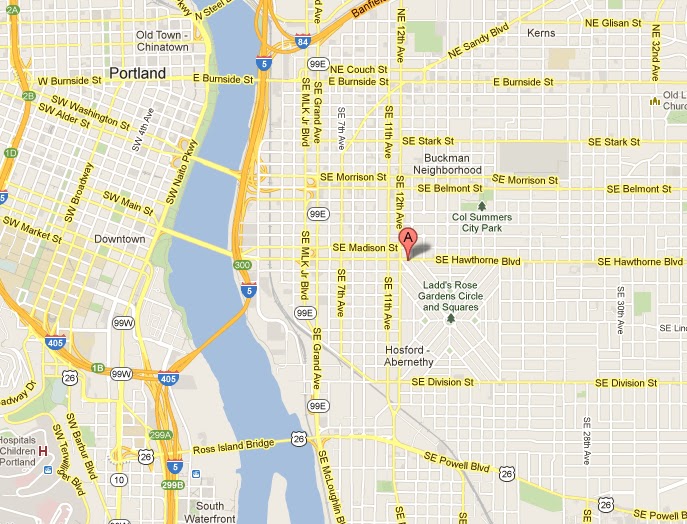
This space at SE 12th Ave and Hawthorne in Portland confused me for the longest time:


For one thing, the diner there had no sign on the outside, so I didn't even know its name until figuring out online that it was called Johnny B's, and at one point did in fact say so across the top of the building.  (Presumably I also could have actually eaten there and figured this out, but I didn't want to, ok?)

Location of Lardo (formerly Johnny B's)
Even more perplexing was the fact that it sits in a prime location at the northwest edge of Ladd's Addition, right near a major intersection...and yet the lot was being used as a parking lot with a small, content-to-be-anonymous diner that hardly anyone seemed to patronize, at least these days.

That all changed recently.  Lardo (formerly a food cart) remodeled the place and decided to use the asphalt for outdoor seating and bike racks instead of car parking.  It drew crowds instantly, and looks like this pretty much every evening:

My shadow is clearly in this for artistic effect
Quite the transformation, but my main point is not about the space's redevelopment per se.  An all-too-common belief is that without providing ample (car) parking - usually for free - businesses will fail.  Although Lardo has a lot more things going for it that contribute to its success, this example provides some evidence to the contrary of this thinking.

So it seems to me that it's possible for customers to adapt to the businesses they want to support, and not always the other way around - which is encouraging for business owners who want to limit the transportation impact of their shop/store/restaurant.  And if doing so brings the added benefit of revitalizing a previously dead space, then it adds value to the surrounding area.  Everybody wins!  Yay.


Update (Aug 13, 2012): This article in The Atlantic Cities talks about Zurich's new parking policy of capping the number of spaces, and turning existing parking into public space any time parking is added elsewhere (in a one-to-one match).  Any guess as to what my opinion is?  

Tuesday, July 24, 2012

Simple solution for bus-bike conflicts


Something they figured out long ago in the Netherlands is that the safest way to design roads is to physically separate the various types of users. Hence the ubiquity of cycle-tracks. This not only reduces conflict between vehicles, bikes, and pedestrians, but it actually improves traffic flows in many cases.

Upon returning to Portland, there have been several instances where I've been riding the bus and the driver has had to wait for several cyclists to pass on the right in the bike lane in order to get over to the stop, then wait again to merge back into traffic. This is especially bad on streets like Hawthorne between SE Grand and SE 12th Ave, where traffic in all forms is high.

More than an inconvenience, it's a safety issue for cyclists. Having buses constantly going in and out of your lane isn't exactly ideal for things like "not getting hit" and "living" and such. Cycle-tracks would indeed be ideal to address the issue, but Portland has been somewhat slow to invest in them, as these are the only two of any significance in the city:
Raised cycle track on SW Moody (Image from swmoodyproject.com)


First cycle track in Portland, on SW Broadway (Image from bikeportland.org)

A full blown cycle-track is not the only option, however.  While the current configuration might look like this (and please forgive my lack of graphic design skills):


It would be a huge yet relatively simple improvement to do something like this:


It would require installation of a concrete island with curb cuts for wheelchair access, but in my mind the increased safety and reduced delays for both bus riders and bikers justify the expense.  Drivers, of course, might experience more delays due to being stuck behind buses loading and unloading passengers, but I don't claim to want to make things better for drivers (even when I'm one of them).  Besides, it really wouldn't be that much worse than the current situation for them since drivers are impacted by the constant weaving of buses and cyclists.  

Update (Aug 15, 2012): My good friend (and Dear Leader) Derek Abe enlightened me to the fact that there is actually a legitimate cycle track on NE Cully in addition to the two I mentioned here. 

Sunday, July 22, 2012

An existential crisis: Is sharing really caring?


So I'm sharing my car on Getaround . If you're not familiar with Getaround, it's a relatively new carsharing company that enables car owners to rent out their vehicles on an hourly, daily, or weekly basis.  An owner sets his price (women aren't allowed), which the renter pays to Getaround, and after taking a commission Getaround pays the owner.  Why bother with the middle man, you ask?  Because Getaround screens, and more importantly insures, the driver.

It's a pretty innovative concept that fills another niche in the carsharing market.  While Zipcar's vehicles are generally high quality and accessible through purely electronic means (no disgusting human interaction required!), it ends up costing more due to membership fees and higher hourly rates than most owners charge on Getaround.  Zipcar is also limited by where they can rent parking spaces for their vehicles (which, judging by the map below, doesn't seem to be a huge barrier).


Zipcar locations in Portland
Car2Go's home area in Portland
Another carsharing service, Car2Go, has a fleet of Smart Cars that are aimed at those who want to make short trips without needing to return the vehicle to its pick-up location.  Users pay by the minute and can leave the car anywhere within a large designated area (see map).  The rate of $0.35/minute (maxes out at $12.99/hour) makes Car2Go generally more expensive than either Zipcar or Getaround, except when rented for an entire day; at that point, Car2Go actually ends up being cheaper than Zipcar.

Clearly there's a decent market for carsharing, at least in a handful of cities around the U.S. and Western Europe.  My question is whether it's really as "green" as it's often promoted to be.  In its favor, it shifts the costs of driving to up-front costs, which plenty of evidence (click here or here) shows to be effective at reducing driving.  It also has the potential to reduce the sheer number of cars in existence if enough people opt to utilize carsharing in favor of car ownership.  In fact, my wife and I made the leap to become a one-car family a couple years ago due to the presence of a Uhaul Car Share vehicle nearby.

On the other hand, carsharing enables driving instead of discouraging it.  Yes, this is America, and discouraging auto-use is akin to being forced to send a Tribute to the Capitol, but I'm skeptical that long term transportation sustainability (I really hate that word) is possible without actively dis-incentivizing driving.

Conveniently enough, the Oregon Transportation Research and Education Consortium (OTREC) is currently studying Getaround and its impact on travel behavior.  I'll be quite interested to see the outcome and whether I can abandon some of my communistic notions.